Showing posts with label learning. Show all posts

19 February 2014

Everyday Adventure Racer Tip #2

Here's the second installment of my "Everyday Adventure Racer" tips series. Hopefully they help you have an enjoyable time in the woods!
http://forums.xkcd.com/viewtopic.php?f=2&t=70099
EVERYDAY ADVENTURE RACER TIP #2: THROW AWAY YOUR GPS

Did you know that you can practice a vital adventure racing skill nearly every day? As far as I'm concerned, navigation is THE MOST IMPORTANT ASSET on the adventure race course. Sure, fitness and teamwork are the engine, but only good navigation can steer your team to the finish line. So why would the aspiring adventure racer hand over that job to to a computer? Every time you fire up your car's GPS, or ask Siri for directions, you are missing out on a prime opportunity to practice your navigation skills. You don't have to be in the woods, or using a topo map, to improve your sense of direction.
Team Alpine Shop prepping maps before the 2013 Berryman Adventure.
Instead, spend a couple minutes with the internet mapping program of your choice. Ask it to create a route between Point A and Point B. And then print out the resulting map, or write down the step-by-step directions/cue sheet, or draw your own map, just do something that will help you remember how to get where you're going. And then, time to navigate! And I'm not limiting this to driving, either. I use the Bicycling feature on Google maps all the time to figure out good ways to get around St. Louis on two wheels. I hardly ever take the first route option, but rather edit the route to fit my own experience with St. Louis streets. I have made literally hundreds of little notes to myself with street names of where I need to go - try it yourself!
There are so many of these floating around my apartment.
But you're probably busy, and don't have time to pre-plan all of your trips. That is okay, I am busy too, it happens. You can still get some nav practice with maps on your phone - just don't rely on the "turn by turn" gps feature. Stop your car (safety first!), get your route loaded on your maps app, and then use it like a paper map to get to your destination. Keep your brain in the game, don't let some Australian-accented-robo-chick have all of the fun!
Jeff's glorious map! Made from the Gazetteer.
Screenshot from a little video I made on top of Shirley Ridge, showing my set-up on the Warbird. Map clip, Jeff's map, Garmin, and a bike computer. Yes I really was going 3.2 mph.
Making your own map can save your butt, too. Recently, I went with my Alpine Shop teammates to a gravel non-race near Steeleville, MO. The non-director had posted a .gpx file for everyone to put on their Garmins, which I did, but my wonderful teammate Jeff also made each of us a hard-copy map of the route from the Missouri Gazetteer. Long story short, around mile 25, the roads got so icy that the ride was no longer fun (or safe!) so we decided to make our own way back to the car. This part of Missouri has limited cell coverage so there was no asking the interwebz for directions. If we'd had only the tiny screen of my Garmin, we would have been screwed, but instead we had Jeff's lovely paper map that showed all of the back roads we could use to get back to the car. Along the way we picked up several other riders who didn't have maps or cue sheets and could have gotten really lost in a rather remote part of the state. I was really, really thankful for my teammate's preparedness on that day. Jeff, as usual, you are awesome!
Carrie, not-a-murderer-David, and Jeff figuring out how to get back to the car.
So, bottom line, don't pass up a chance to navigate. GPS and turn-by-turn navigation can be useful tools in an emergency, but if you have an extra minute or two, invest in your own map-making and map-reading skills. It will pay off BIG TIME on the race course. I also recommend going to orienteering meets as much as you can, but this series is about things you can do EVERY DAY. So, happy navving!

WANT MORE?
http://www.arcalifornia.org/getting-started-new/start-navigating/389-the-best-navigation-guide-for-adventure-racing
http://nyara.org/navigation-orienteering-tips/
http://www.navigationtips.com/wordpress/?p=154
NPR agrees! http://www.npr.org/blogs/health/2014/06/05/319098669/the-gps-in-your-head-may-work-a-lot-better-than-that-phone

Pin It

14 January 2014

Everyday Adventure Racer Tip #1

I've been thinking a lot lately about how adventure racing is really hard. The learning curve is incredibly steep. So steep, in fact, that teams can get discouraged really quickly and quit before the ever get to experience the joys* of racing through the night, with wet feet. And wet clothes. And wet food. But man, when the sun comes up, and that next checkpoint comes into view, the sense of team accomplishment is so incredible that it keeps me coming back for more, again and again. I. Love. Adventure racing.
http://forums.xkcd.com/viewtopic.php?f=2&t=70099
And I want other people to love it too. I admit that I am certifiably obsessed with the sport, perhaps to a degree that not everyone is willing to go. But there are some simple things, beyond training a ton, that anyone can do to become a better adventure racer. And I want to share those here, so that maybe your next adventure racing experience is a tiny bit better. I have a bunch of tips in mind but I'm just going to share them one at a time to make these posts short-n-sweet.

EVERYDAY ADVENTURE RACER TIP #1: HUG YOUR TEAMMATES.
IMG_5142
Alpine Shop super-team at 2013 Berryman 12hr
http://www.bonkhardracing2.com/PhotosBMA2013/finish-line-5-by-mary-welte/img_5142.html
Yes I said hug. Or at least a handshake, or at the bare minimum a high-five, if you are just meeting them. Ideally you should do this every time you see them, train with them, race with them, drink with them, etc. Share the adventure racing love!! Like I said above, this sport is HARD, and you'll be surprised at the lengths to which your teammates will go if they know that you care about them. It's important to keep this in mind during races, too. Did your teammate just wade through that swamp for the checkpoint punch so you didn't have to? Pat them on the back. Did your navigator just lead the team directly to the checkpoint flag in the middle of the night? Hug them. Did your teammate just give you their last piece of pepperoni because you didn't bring enough food on the trek? At least offer to split it, and then hug them. This is a team sport, people, and a little appreciation goes a tremendously long way.
Puppy pile optional.
Boonecrusher 12hr AR 2013, racing with Gnome Hunters!
Further reading:
Dude, It's OK To Hug Your Bro

IMG 2904
http://www.bonkhardracing2.com/PhotosBM2012/various/img-2904.html
*joys: OK, maybe racing through the night soaking wet isn't exactly awesome, but, you can't always be having Type I Fun.

Pin It

27 March 2013

Meet the Warbird Part TWO

BIKE NERD ALERT: Here is my exact build of my new Salsa Warbird. As you can see, if I had ordered the complete bike, I would have ended up changing a lot of things anyway. I think the key component here is the SRAM X0 crank, specifically the 29/42T option. It's taller than a typical mountain crank (26/39T), but smaller than typical cyclocross set-up (36/46T). Or in other words, it's perfect for the OGRE. I have no worries that my bike will be up to the task of 11,000 feet of climb. Just hope my legs can hang in there!
Frameset
FrameWarbird EV6 Aluminum
ForkENVE CX Disc, Carbon, Tapered
Drivetrain
Front DerShimano CX50

SRAM X9
Rear DerShimano 105

SRAM X9
CassetteSRAM PG-1050 11-30T

SRAM 1070 11-36T
ChainKMC X10

KMC X10SL GOLD!
CranksetFSA Gossamer PF30 34/46T

SRAM X0 28/42T, 170mm 
Components
Rear Shocknil
HeadsetCane Creek 10 IS42/56
StemSalsa Pro Moto 2

cheapo Easton 90mm aluminum
HandlebarSalsa Cowbell 2
GripsSalsa Gel Tape
ShifterShimano Tiagra STI

SRAM Rival
Front BrakeAvid BB7
Rear BrakeAvid BB7
Brake LeverShimano

SRAM Rival
Rotors160mm Front/140mm Rear

Ashima 160mm Front/160mm Rear GOLD!
SeatpostSalsa Pro Moto 2

Easton Haven 27.2mm
SaddleWTB Valcon

Bontrager something

ISM Adamo Racing II
TiresClement USH 700c x 35mm

Clement LAS 700c x 33mm

Ritchey Speedcross 700c x 40mm
Wheels
Front HubSalsa 2 by Formula, 32H

Rival 32H disc GOLD!
Rear HubSalsa 2 by Formula, 32H

Rival 32H disc GOLD!
SpokesDT Swiss Competition white
RimsSun Assault No Brake Track

Velocity A23 white

Other Small Parts
  • PF30 bottom bracket
  • Jagwire Road Pro XL kit for the cables/housing. I got this in the sparkly GOLD MEDAL colorway. We got the XL kit to make sure there was enough housing for full-length coverage, which Salsa designed into the frame's bosses. 
  • Inline barrel adjusters for shift cables. Decided not to use them on the brake cables (instead going to rely on the BB7 calipers inboard adjusters if needed).
  • Gold spoke nipples
  • Gold bottle cages
  • Clear chainstay protector from Lizard Skins
  • Walmart-brand bento box and REI-brand saddle bag

I've said it before but I'll say it again...this bike would not have been possible without SIGNIFICANT help from the guys at Big Shark, especially Doug, Colin, Dirk, Dave, Matt, and Howard. They helped me with with frame selection, sizing, component installation, wheel building, and a bunch of other stuff. I brought the completed bike over to the Loop store last night and their reaction when I brought it into the shop area was priceless!! Thanks again for the help and encouragement, I'm so stoked about this bike and ready to crush some gravel! Pin It

26 March 2013

Meet the Warbird

Let me be clear, I had no intention of buying not one but two new bikes this year. It just, sorta....happened. Bike people will understand. It all started with me agreeing to race the OGRE with my Alpine Shop teammate Jeff. When I first heard about this 154-mile gravel race with crazy amounts of climb, I had absolutely no interest in doing it. Too long, all one discipline, just didn't inspire me. To be honest it didn't interest any of my friends either. But for some reason the idea kept sticking around, kept getting talked about as a sort of "can you believe some people are actually going to do this?!" and then before I knew it Jeff flipped. He recruited a support crew (Carrie) and dangled it in front of me like a gravel-dusted carrot...okay. Fine. I'm in. Go Uncle Perv & The Pervette.
Me, Jeff, and Carrie on a training run at Chubb.
Then came the question of the bike. The OGRE promoters issued this lovely little snippet on their website to assist racers in bike setup:
Riders should expect to descend equal to the elevation gain estimated at 75ft - 80ft per mile. Tire selection and gearing choice are critical to completing this up and down race. The Oz Cycle group that rides these roads regularly suggest that tires be at a minimum of 700 x 35 (they use 700 x 40 or 29er 1.75-2.0) with low profile tread and lateral knobs. Gearing should be no higher than 42/27 crank, 11-34 cassette. Pushing a granny gear of 24x36 or 22x34 will come in handy 100 miles into the race, so go lower if you have it.
I had planned to use my cyclocross bike (a Cannondale CAAD8 from 2009 or so) but this little paragraph made me VERY worried about gearing. See, the Cannondale had a normal 46/36 crank with an 11-28 cassette in the back. And let's do the math...a 154 mile race with approximately 75 feet of climb per mile means...MORE THAN 11,000 FEET OF CLIMB. ON GRAVEL. This is serious. I took it in to my friends at Big Shark to talk options. Could I just switch cranks? Maybe put a mountain bike cassette on the back? Turns out, there was no simple answer. The Cannondale's Shimano road components don't play nicely with the mountain bike options I wanted. Plus, the cantilever brakes were touchy at best and scarily unreliable at worst. Oh dear...this smells like a new bike.
Me and the Cannondale at Hermann Cross 2009. Photo probably by Dan Singer.
More research. More spreadsheets. Steel? Aluminum? Mountain bike frame with drop bars? Cyclocross frame with wide tire clearance? Maybe throw skinny tires on the SegSlayer? (Wo)man up and ride the Cannondale with a 46/34? Thankfully, Uncle Sam chipped in with a well-timed tax refund. With the direct deposit burning a virtual hole in my pocket, I marched back over to Big Shark, spent even more time talking to their people (saints, all of them), and came away with an order for a brand new 2013 Salsa Warbird frameset. I had crunched the numbers and initially wanted to buy the complete bike (with plans to immediately replace about half of the components), but turns out there was no more stock left so frameset it was!!

The cool thing about the frameset was that I could build it EXACTLY how I wanted. The bad thing about the frameset was that I had to source every single piece and part myself, checking compatibility, availability, pricing, ship times, etc. It was tedious but...I learned A LOT. Like there are different versions of BB7 brakes for mountain and road levers. Like rear axle spacing. Like shift cable diameter vs. shift housing diameter vs. brake cable diameter vs. brake housing diameter (1.1mm, 4.5mm, 1.6mm, 5mm). Like headset specs. And don't forget the ferrules!! It was an absolute fire-hose amount of information but again, I had a speadsheet to take it all in.


Once the parts started rolling in, it was time to start assembling. I did some things myself, but I relied very heavily on Big Shark mechanics for stuff that was beyond my knowledge/skill level, or that I simply didn't have the tools for. Colin installed my bottom bracket, crank, and headset/fork. Then I did the seatpost/saddle, spacers/stem/bars/shifters, first pass of housing and cables, front and rear derailleurs, temporary wheelset, and chain. I messed with the cable routing for a considerable amount of time, mostly because this is my first build and I wasn't familiar with how much radius is too severe or too lax. Finally, I took everything over to Doug's house for final review and to build some sweet wheels.


Doug basically went over the entire bike, checking the work I did and fine-tuning almost everything. We installed inline adjusters that actually fit the 4.5mm housing. We took slack out of the brake housing, checked ferrules, adjusted derailleurs, and drank bike-related beer. I asked A LOT of questions. After that was all done, we still had wheels to build! I helped where I could and by the end of the evening, we had a mostly-done rear wheel and a half-done front wheel. Doug offered to finish up both wheels, cut my (kharbon) steerer tube, and tape the bars the next day while I was running an O-meet. I happily accepted that offer and went on my merry way.

And oh, what a merry way that was! I picked up the Warbird and immediately had to crush some afternoon Katy gravel. I had lost my Garmin at the O-meet (sad) but I put about 3 hours of ride time into the bike right off the bat. Nothing crazy hard, just a few solid miles in peaceful Missouri countryside. Let me tell you...this bike...it just hums. It eats up the miles and is such a pleasure to ride. If I'd had a credit card with me, I would have kept riding to Jefferson City, got a hotel, and then ridden back the next day!

Detailed build specs here.
Pin It

14 February 2013

Planning the 2013 Season

Planning for 2013, the first half of it at least, is finally complete-ish. As with most big decisions, I rely a lot on my gut feeling and this year, my schedule took a while to really come together. Mostly, it was my indecision regarding triathlon. I love me some swimbikerun, but I got a taste of top-level adventure racing in the fall of 2012 and I had a hankering for more. Trouble is, adventure racing is a team sport, and I was all by my lonesome. I knew I could pick up races here and there as a substitute (teams are almost always looking for female racers) but that stresses me out a little, and I'd prefer to keep any and all forms of stress at a minimum. So I kept peeking at individual events like triathlons and mtb races, even asking facebook what I should tackle as a BHAG for 2013.
http://explodingdog.com/
After much deliberation, both extro- and introspective, I decided to focus on a race format unique to the Midwest: the gravel grinder. A gravel race is an endurance biking event held almost entirely on backcountry gravel roads. The course is only minimally marked or sometimes not marked at all except for a paper map/cue sheet. Race distances span from 100 to 300 miles and beyond. Most people use cyclocross bikes, but some have been known to ride modified mountain bikes for increased comfort as the miles stack up. Most races/events enjoy a very dedicated following and they focus on a grassroots atmosphere that calls to my soul.
Now THAT is a man-train. 2012 Cedar Cross.  Photo from http://karenholtmann.blogspot.com
So there I was, signed up for two very intimidating gravel events: the OGRE 150-miler in April (with Jeff from Alpine Shop) and the Dirty Kanza 200-miler in June. And then, my friend/inspiration/hero/all-around badass Carrie from the Alpine Shop AR team hurt her knee and asked me to sub for her at Bonk Hard's LBL 18hr AR. Then she got an MRI and found out she would be on the sidelines for longer than just LBL. And BOOM...suddenly my schedule filled up with more adventure races than I had ever thought possible. With a team known for speed and good sportsmanship. If it weren't for Carrie's injury, I'd say it was the perfect scenario. But hopefully when she recovers there will still be a team out there with a spot for me!
Alpine Shop teammates Jeff and David before the 29(mile)r.
They wore the EXACT same clothes without planning it. Nerds.
In the meantime, here's where you can find me in 2013, confirmed races in BOLD:

16-Feb: Bonk Hard LBL Challenge 18hr AR (with Alpine Shop, 4-person coed)
16-Mar: Bonk Hard Chill 12hr AR (with Alpine Shop, 4-person coed)
6-Apr: CAC2 (tentative, still putting together a team, email me if interested)
13-Apr: Tour of Hermann Gravel Stage Race (tentative)
20-Apr: Bonk Hard OGRE 150mi gravel race (with Uncle Perv, 2-person coed)
27-Apr: The Boonecrusher 12hr AR (with Gnome Hunters, 4-person coed)
4-May: Cedar Cross 100mi gravel non-race (tentative)
11-May: DINO Mission 18hr AR (with Alpine Shop, 3-person coed)
18-May: Planet Adventure 24hr AR (with Alpine Shop, 4-person coed)
1-June: Dirty Kanza 200mi gravel race (individual)
24-August: Thunder Rolls 24hr AR (with Alpine Shop, 3-person coed)

As you can see, April and May are PACKED. The only reason that Cedar Cross is tentative is I'm worried about excessive fatigue and wanted to give myself some breathing room in case my legs are fried at the end of April. What happens after Thunder Rolls is anyone's guess. It depends a lot on Carrie's knee, and some race schedule conflicts. But stay tuned here and you'll be the first to know! Pin It

03 January 2013

How-To: Love Mountain Biking

It's January. Cue the onslaught of "2012 In Review" blog posts. Phew...now that that's off my list, I've had another post turning around in my bran that I want to share: how-to love mountain biking. I have not always loved this great sport. In fact, for a good 12 months (maybe more), I was downright fearful of knobby tires. I only bought a mountain bike in the first place because a cute boy asked me to go adventure racing way back in 2009. Truthfully, I was scared out of my mind of riding on anything besides pavement, but I said yes anyway because I felt daring for 30 seconds. And then got scared again.
Blast from the past! Me riding my 26" hardtail, with V-brakes in the 2009 Castlewood 8hr AR. Oh yeah.
I found a bike on craigslist that sounded like it could complete an 8hr AR, and promptly bought it. A very kind co-worker took pity on me and the 2009 Specialized Women's Myka HT Comp. I brought it over one day and we (uh...he worked and I watched) gave it a thorough tune-up. Then we took it out for a quick spin on the very-beginner-friendly singletrack at Creve Coeur Park. And, I kid you not, I crashed in the first 10 feet of the trail, trying to ride over a 1 inch twig. Not exactly a good omen for trail confidence! We finished out the ride with no more catastrophes, but it was clear that I would have to work hard at gaining any sort of handling skills on the dirt.
Dirt Crits, "C" race, 2010.
Summarizing 2010 and 2011, I rode my mountain bike occasionally. Most of my rides involved some level of fear/apprehension/anxiety when we were on singletrack. I remember doing lots of night rides at Lost Valley with a great group of women, and being sincerely relieved anytime we popped out onto the doubletrack for a few miles. I was never scared enough to say "no" to a mountain bike ride, I was just always grateful when it ended.
Finish line at 2010 LBL 24hr AR.
In 2012, that all changed. Now I relish riding my mountain bike, I look forward to singeltrack, and I am sad (usually) when it's time to finish the ride. I can attribute my change of heart to a few reasons and I'd like to share those, in the hopes of encouraging any aspiring mountain bikers to enjoy this wonderful sport.
Mid-race at 2012 CPT Nats.
#1: Walking is okay. 
If you've found your way to my blog, chances are you are already an adventurous sort, reluctant to admit that anything is "too hard" or "too dangerous" or "too scary". I certainly felt that way about technical singletrack when I started riding mountain bikes. I forced myself to ride anything and everything with the skills I had at the time. That led to a lot of crashes, or near crashes, or putting feet down, and generally reinforced my subconscious fear of rocks and roots. This year, I adopted a completely different approach: I walked. When things looked too scary for me to ride them on-sight, I hit the brakes and got off the bike. No guilt. I would take a few minutes to look at different lines, visualizing myself riding the correct one, and then either get back on the bike for a try, or just walk through the tricky section. This strategy isn't going to win you any races, but it helped my confidence a lot to have those few extra looks at the hard stuff. It also helped that I ride a lot of the same trails, so on the next visit to that area, I would be more likely to attempt something on-sight. That built my confidence in a way that barreling through obstacles never could. Again, this strategy doesn't help to build speed, instead it builds skills/confidence, which will translate to smoother riding that is ultimately faster.
2012 Crankworx 3hr in Cape Girardeau. MO.
#2: Lean into your turns.
There is a certain person on my mountain bike team who is notorious in the St. Louis community for being.....direct. As in, if he thinks you're wrong, you'll hear about it, loudly. Which can be intimidating for an inexperienced mountain biker like me, but when I ride with this dude, I have found that he is nothing but helpful and encouraging. This piece of advice came from a session at Greensfelder where I was struggling with downhill switchbacks (and I continue to struggle with them, but with this advice in mind). It sounds counter-intuitive, but when riding downhill turns/switchbacks, you need to lean forward and over your handlebars to put weight on the front wheel, which improves traction and reduces the chance of washing out, allowing you to carry more speed (read: brake less) through the switchback.
2012 Alpine Shop Dirt Crits, "B" race. Photo by Dan Singer.
#3: When you get scared, let go of the brakes.
This one is a gem taught to me by my riding buddy and mountain bike teammate Sally. We were riding (also at Greensfelder) through a gravelly, washed-out downhill section full of shelf-y rocks, where the best line is an S-curve. It's tricky, and I had a death-grip on my brakes trying to creep the bike along. She would not have any of that. "Emily, when you get nervous, you need to let go of the brakes, just for one second, let the bike right itself underneath you and then you can slow down again". The thing about most mountain bikes is, they want to stay upright. The want to keep moving forward. So when a nervous-nellie rider snatches at the brakes, the bike's natural momentum gets disrupted and you're more likely to lose balance and crash. So force your fingers to let go of the brakes, allow the bike to track a few seconds, and then check to see if you actually need more brakes. Chances are, you won't.
2012 Burnin at the Bluff.
#4: Pedalpedalpedal.
This one is a mantra taught to me by one of my most frequent riding partners. Once you get your confidence up, speed is your friend. Really. 90% of the time I screw up riding tricky stuff, it's because I didn't have enough speed. Sometimes it's because I was intimidated, or maybe I didn't realize that an obstacle was coming up, but slowness can really hurt your chances of clearing a tricky section. Of course, it can also increase your chances of a harder crash, but that's why your confidence needs to be in place before adding momentum. But one of the biggest lessons I've learned this year is that you can clear SO MANY tricky sections just by staying balanced and pedaling. Pedalpedalpedal.
Me, The Claw, Struckman, Young Ben, Sally on a training ride. The trails were too wet that day. Photo by the Pfoodman himself.
#5: Find a great crew of riding buddies. AND RIDE.
You don't all have to be the same speed. I ride with people faster than me A LOT. And either they're content to ride behind me (saints), or they wait at various spots on the trail for a re-grouping. Both strategies are fine with me, I'm just glad to have company in the woods. Solo road riding is cool, but I prefer to have another person with me on singletrack just for safety. But the only way you are going to get better at something is to DO THAT THING. It wasn't until 2012 that I started to put significant and consistent miles in on my mountain bike. Surprise...it wasn't until 2012 that I started enjoying myself on the trails. So thanks to HH, the Alpine Shop crew, and the Pfoodpeople for riding with me so much!
We have an amazing group of mtb women in STL. Photo from 2011 Castlewood XC race.
OK. So that's EK's Top 5 Tips for Loving Mountain Biking. Hopefully they will help if you are a newish rider. But hey, I still consider myself a newish rider. I'm just trying to put some suggestions out there and see what sticks. If you have other tips please leave a comment!!
Pin It

19 September 2012

AR Glossary

When I posted one of my recent AR race reports, my grandma emailed me (from her iPad!!!) asking about some of the terms I used. She only asked about three or four but I wanted to make a more complete glossary for any non-adventure racers out there who want to learn more about the sport. OK! Here goes.  

GENERAL
Schwag - Promotional items racers receive at check-in. Usually some type of shirt, but could be socks, a hat, a blanket, a backpack, etc. Schwag also includes product samples (like energy bars or gels) provided by sponsors. 

Tow, Towing - Sharing energy among teammates with the use of a tow rope. This happens most frequently on the bike but can happen on the run or even while paddling too. Racers make all sorts of different tow set-ups but most of them involve non-locking carabiners and bungee cord. Contrary to popular belief, the person being towed still has to pedal/run/paddle. The tow is mainly for giving them a slight boost every so often from the stronger teammate (and to keep them in the draft zone while biking/paddling).
Me unhooking the running tow, with the passport in my hand, approaching a checkpoint with a punch hanging from it. (Castlewood 8hr AR 2010)
Trek - Moving through the woods on foot. Top teams run whenever they can and fast-hike the rest. Almost all trekking sections require teams to also navigate using their maps and a compass.

Plotting - Marking the location of race checkpoints on race maps. Race directors (RDs) will hand out a set of UTM coordinates that describes the location of each checkpoint, and teams are responsible for accurately plotting these onto the map. Plotting incorrectly is called misplotting and can lead to huge time losses while racing.

Gear check - A point either before or during the race where teams have to prove to race staff that they are carrying all mandatory gear (example list here). It is important to keep your pack organized so you can quickly show race staff the required items (they can ask to see anything from the list).

Punch - A device that looks like an orange stapler located at each checkpoint. The punch has a unique pin pattern that teams punch on their passport to prove that they visited this checkpoint.

Passport - A piece of durable paper (usually card stock or tyvek) that teams punch at each checkpoint to prove they visited it. Also called the punchcard. 

The canoe put-in (Smithville 8hr AR 2010)
Put-in - The location where teams start a paddling leg, i.e. where they put their boat(s) into the water.

Take-out - The location where teams finish a paddling leg, i.e. where they take their boat(s) out of the water.

Bonk - In endurance sports, to experience severe fatigue due to lack of fueling and improper pacing. Not a good strategy for winning races.

Hike-a-bike - To push your bike when the trail is non-existent or too difficult to ride.

Bike-whack - To push your bike through the woods where there is no trail. Similar to bushwhacking, except much slower.

ABBREVIATIONS
CP - checkpoint. These are the locations teams try to find during the race. They may be on- or off-trail, manned or unmanned, and the race rules will describe if they are mandatory or optional. Checkpoints are usually marked with orienteering flags. In an orienteering race, they are called "controls", but adventure racers call then checkpoints. Each CP has a way to verify the team's arrival, usually a punch (see above).
In a TA at 2010 Castlewood 8hr AR.
TA - transition area. This is where teams switch between disciplines, usually requiring a change of clothing or equipment (from running shoes to biking shoes, for example). Quick transitions are essential to a winning team.

HQ - race headquarters. Usually the site of the start and/or finish.

UTM - Universal Transverse Mercator, the coordinate system used by races to describe CP locations.

nav - navigation.

ORIENTEERING

Anything I missed? Leave a comment and I'll update this post!
Pin It

20 June 2012

IMCdA: The Soundtrack

I believe in the radio gods. Which is funny because my car does not have a radio ('twas stolen, and I’m too lazy to replace). But perhaps the equivalent thing in my life is the shuffle gods, whom I trust to pull up the most applicable song for the current situation. Over past three seasons, these 'deities' have masterfully delivered inspiring songs right before my big races that I keep in my head during the event. In 2010, it was Ragged Wood before the Lake St. Louis Olympic Tri. In 2011, it was Pumped Up Kicks before ITU Long Course Worlds. And now, the shuffle gods have pulled up Some Nights straight from the depths of the interwebz and into my earbuds. And I can’t get enough. In the last 5 days, I’ve listened to fun. at least 20 times (wait, let me check iTunes…yep….32) and I plan on keeping it on repeat right up until I have to turn my morning clothes bag in on Sunday. And even once the iPod is gone, the song will continue to circulate in my mind and I’ll probably even sing a little bit out loud on course. Competitors, beware!!
Singing??
I always love it when athletes share their playlists so here are a few other songs that have got me through this Ironman build:
For The Beauty Of The Earth – traditional, but I like the Steve & Danny Thompson version, even though it's a little Enya-ish...it's got good tempo.
In The Mood – traditional, but I like the Glenn Miller Orchestra version
But on a more serious note, Some Nights is the perfect song for me right now. This ironman build has allowed me to get a good look at what long-course triathlon training is all about. It's lonely. It's hard. I never really wish[ed] that it all would end, but I could use [training with] some friends for a change. And now that I've almost reached the end of the road, I'm still not sure what I stand for...Triathlon? Adventure racing? Can I do both? Do I want to do both? Do I want to just sit on the couch? I've put a lot of time and effort into preparing for my first Ironman, but I still have no idea how things will go competitively on race day. Will I be at the pointy end of the field, maybe in my age group? Or not even close? And if I'm not close, will I be satisfied?
IM training in a photo: Easy St...STREET NOT THRU!
One thing that sticks out most in my head for this training cycle is the amount of times I've said "no". No to mountain bike rides. No to adventure races (even subbing on really fast teams). No to sleeping in. There hasn't been much balance and I'm not sure I like that. On one hand, I take a lot of pride in executing my training day in, day out. On the other hand, would IMCdA be ruined for me if I hopped on my mountain bike for a dirt crit? That's a slippery slope to start down, and for my first IM I preferred not to stray off the path of 100% dedication. 
Last long ride...view of the cockpit.
But the balance will be struck in the month of July, and possibly the rest of the summer. There is some dirt in my future, hallelujah! I have a few events picked out even, and I'm super stoked to do some non-triathloning.   Don't get me wrong, I still love me some swimbikerun, I just need to swing the training pendulum of my life back towards to off-road side of things for a bit. And I'm still not sure where that pendulum will eventually land, it's all a part of the process, figuring these things out.
Tater bikes go in a tater trailer. Loading up on Monday night.
So I've raised a lot of questions that you probably weren't expecting. Honestly, they've been brewing in my head for weeks but I wasn't really expecting to write about them here...just...after the playlist, this post seem sort of short so I kept rambling. Sorry if it's too mental, at least you got a good list of songs out of it!
Pin It

29 May 2012

An Evening with Chrissie Wellington

I'm fortunate enough to live in a larger city that attracts interesting visitors. Last year, I met Sister Madonna Buder, Iron Nun. Earlier this year I listened and learned from Andrew Skurka, Ultimate Hiker. And last night St. Louis enjoyed a visit from the reigning (4-time) Ironman Triathlon World Champion, Chrissie Wellington. Of course I went.
Chrissie answering a question!
The funny thing about these type of events is I rarely go with questions of my own. These people and their areas of expertise are on youtube enough times that I can research answers to my specific questions without too much trouble. Instead, I go to soak up their aura, see how they convey their thoughts, respond to the inevitable repetitive questions, and gather my own inspiration.
from http://www.bbc.co.uk/sport/0/triathlon/17460802
And Chrissie is indeed an inspiration. The girl could hardly sit still on stage, flapping her feet around and changing positions every minute or so. I suspect it is this energy that, when training, she is able to channel into gaining fitness, but it an off year just sort of bubbles out of every nook and cranny. Chrissie gave a short auto-biographical talk about her ascent to the ultimate title in long-course triathlon, and then took questions from the audience. Throughout her presentation, I was impressed by her insistence that every person work to achieve the best race result for you: not stressing about the clock, but instead focusing on wringing every last ounce of courage out of yourself and leaving it on the racecourse. This inward focus extends to training as well...focus on preparing yourself the best you can given your life situation and choices. Not every age grouper has the luxury of adequate recovery, balanced nutrition, good sleep, terrific equipment. Chrissie encouraged us not to measure race performances by the depth of our aero wheels...instead measure them by the depth of our efforts.
Meeting the legend.
My biggest take-away from her talk was from a crowd question. An attendee asked "What advice would you give to a person attempting to finish their first Ironman?" Now at first I was not impressed by this question; there is advice for first-time triathletes floating all over the interwebz. But Chrissie's answer really impressed me and it is something I will incorporate into every pre-race routine from here on out. She responded "I would tell the athlete to set aside some quiet time and think about the day ahead. Think about what it would take to make you quit." She went on to describe that the only thing to make her quit would be a broken leg, so when she races and is feeling bad, she asks herself "Is my leg broken?". Then if the answer is no, then she keeps going. Simple. Perpetual forward motion.
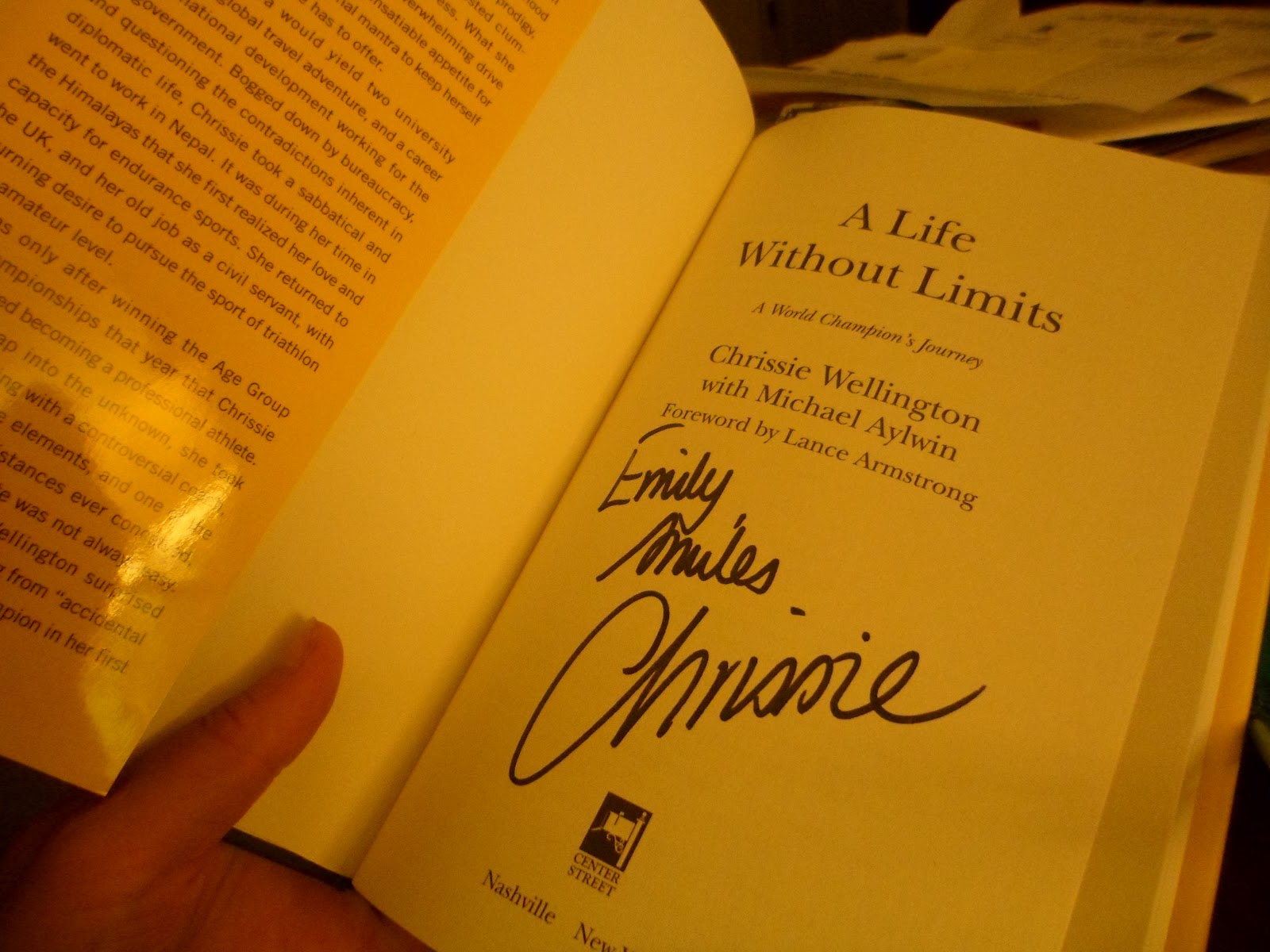
My new book!


Pin It